
Somebody at a barbecue will always tell you it’s illegal to eat an orange in the bathtub in California. Somebody else nods along. Nobody has ever met the person who got the ticket.
That one isn’t real. But the story keeps traveling because plenty of genuinely strange rules in this state are real, and a handful of them can still cost you money in 2026.
I spent a long career reading statutes that made me tilt my head, and California produced more than its share. Most lists of weird laws in California just recycle the same inventions year after year. The fifteen below hold up when you go pull the actual code section, and I’ve told you where each one lives so you can check me.
A few are museum pieces. A few could show up on a citation this month.
Weird laws in California that are actually real
1. Fake whiskers can be a crime
Penal Code section 185 makes it a misdemeanor to wear a mask, false whiskers, or any disguise to avoid being recognized while committing an offense or running from one. That whiskers language has sat there since 1873 and nobody has bothered to modernize it.
2. Borrowing a lodge pin to get a favor is illegal
Penal Code section 538b makes it an offense to wear the badge or insignia of a fraternal order you don’t belong to in order to get aid, business, or charity. A saloon era grift, preserved in amber.
3. Rubbernecking at a crash can land you in jail
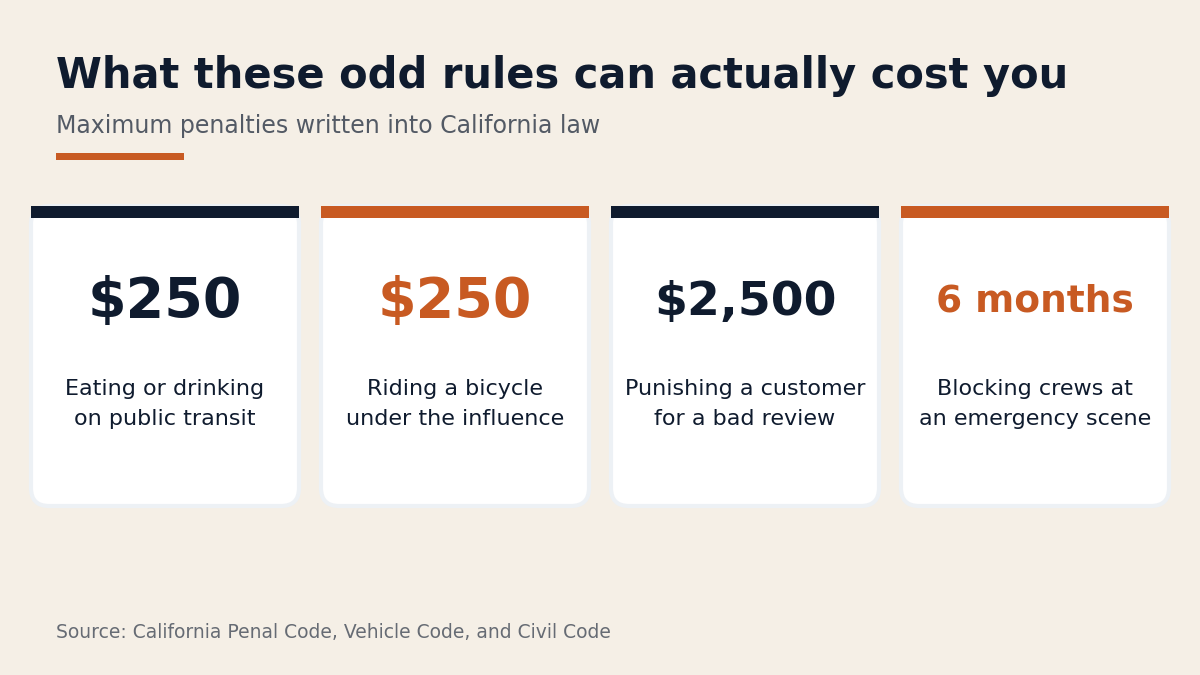
Under Penal Code section 402, stopping at an emergency scene just to watch, in a way that actually blocks police, firefighters, or paramedics from working, is a misdemeanor carrying up to six months in county jail. Watching isn’t the crime. Getting in the way is.
4. Your sandwich on the train can be an infraction
Penal Code section 640 covers eating or drinking on a transit vehicle or in a station where the system prohibits it. The maximum is a $250 fine plus up to 48 hours of community service.
5. A frog that dies at a jumping contest can’t be eaten
Fish and Game Code section 6883 lets you keep as many live frogs as you like for a frog jumping contest. If one dies, it must be destroyed right away and may not be eaten or used for anything else. Written in 1957, and yes, Calaveras County is the reason.

Four odd rules hiding in the Vehicle Code
6. Nobody rides in the trunk
Vehicle Code section 21712 makes it an infraction to knowingly let a passenger ride in the trunk. It also bars towing a trailer, camper, or boat trailer with someone inside, apart from certain fifth wheel coaches that meet safety requirements. It covers towing a person on a bike, a sled, or skis too, which tells you what people were doing when this passed.
7. That air freshener on your mirror is technically a violation
Vehicle Code section 26708 bans anything hanging in front of the windshield that obstructs or reduces your clear view. A pine tree air freshener, a graduation tassel, a rosary, all of it can qualify. Courts have held an officer still needs a reasonable belief the object really blocks your view, so it isn’t an automatic stop.
8. Your stereo has a legal loudness limit
Vehicle Code section 27007 says you can’t run a sound system on a highway if it can be heard 50 feet or more away from the car. Emergency vehicles, utility trucks, parades, and political events are carved out.
9. You can get cited for drunk biking
Vehicle Code section 21200.5 covers riding a bicycle on a highway under the influence of alcohol or drugs. It’s a misdemeanor, but the penalty is capped at a $250 fine with no jail, and it doesn’t hit your driving record the way a car DUI does. If you want to know how the roadside stop itself works, our guide to what you must do and can refuse at a DUI checkpoint walks through it.

Three rules about what you can own, sell, and say
10. Pet ferrets are still banned
California lists the domestic ferret as a restricted species under Title 14 of the state regulations, and Fish and Game Code section 2118 bars possessing restricted animals. Only one other state does this. The Fish and Game Commission accepted a petition to revisit it in June 2025, but nothing has changed, so the ban is still in force.
11. Foie gras can’t be sold here
Health and Safety Code section 25982 prohibits selling any product in California that came from force feeding a bird to enlarge its liver. It survived more than a decade of litigation, and in 2023 the U.S. Supreme Court declined the case, leaving the ban standing.
12. A business can’t punish you for a bad review
Civil Code section 1670.8, nicknamed the Yelp law, makes it unlawful to put a clause in a consumer contract waiving your right to say what you think about the business, and unlawful to penalize you for saying it. Penalties run up to $2,500 for a first violation and up to $10,000 for a willful one.

Three city ordinances that sound made up
13. Carmel by the Sea wants a permit for your heels
The city’s municipal code chapter 8.44 asks anyone wearing shoes with heels over two inches, or with a base under one square inch, to get a permit from the City Clerk. The city attorney wrote it in 1963 so Carmel couldn’t be sued when visitors tripped on sidewalks buckled by tree roots. The permit is free, and nobody gets cited for skipping it.
14. Bothering a butterfly in Pacific Grove is unlawful
Chapter 11.48 of the Pacific Grove code makes it unlawful to molest or interfere with the peaceful occupancy of the monarch butterflies during their annual visit. If a swarm settles somewhere truly inconvenient on private property, you apply to the chief of police to move them.
15. Chico is a nuclear free zone
Section 9.60.030 of the Chico code says no person shall produce, test, maintain, or store a nuclear weapon or a nuclear weapon delivery system inside the city. Adopted in 1983, and genuinely on the books.
The famous ones that turn out to be myths
The weird laws in California that get shared most are usually the fake ones. Three worth retiring:
- The orange in the bathtub. No statute, no ordinance, no citation anywhere. Researchers have combed the state’s legislative database for it. It doesn’t exist.
- Whistling for your lost canary before 7 a.m. in Berkeley. Berkeley does limit unreasonable noise early in the morning. No canary appears anywhere in the code.
- The $500 fine for setting off a nuclear device in Chico. The ordinance is real. The fine isn’t. That penalty language was floated in 1983, became a national punchline after Johnny Carson got hold of it, and was edited out before adoption.
Why any of this is still sitting in the code
Repealing a law takes the same floor time as passing one. A bill has to be authored, heard in committee, voted through both houses, and signed. Nobody gets reelected for deleting a sentence about false whiskers, so it stays.
The other half of the answer is that some of these aren’t as silly as they sound. Take Diego, who drives a delivery van in Sacramento with a small stack of air fresheners swinging off his mirror. He got pulled over, and the stop turned into a citation under section 26708 plus a long look at his paperwork. The mirror rule sounds like trivia right up until it becomes the legal reason an officer walked up to your window.

Common mistakes people make with laws like these
- Trusting a listicle over the code. Most of those pages copy each other and never cite a section. No code number, no law.
- Assuming an old law can’t be enforced. Age repeals nothing. A statute from 1873 is as valid as one from last year until the Legislature strikes it.
- Confusing a city ordinance with state law. Carmel’s shoe permit binds nobody in Fresno. Local rules stop at the city line.
- Arguing the law is dumb instead of arguing the facts. A judge can’t repeal a statute from the bench. Fight the evidence, not the wisdom of the rule.
- Ignoring a small citation. A tiny ticket you never answer becomes a real problem once the court adds fees. Our walkthrough on how to fight a parking ticket covers the process.
Key takeaways
- All fifteen are real, and each has a code section you can look up yourself.
- Several carry actual money, including a $250 cap for transit snacking and for drunk biking, and up to $2,500 for punishing a customer’s review.
- The most famous weird laws in California, the bathtub orange included, are inventions.
- City ordinances only apply inside that city, so check whose rule you’re reading.
- Old and strange doesn’t mean unenforceable.
Frequently asked questions
Is it illegal to eat an orange in the bathtub in California?
No. There’s no such statute or ordinance anywhere in California law. The claim seems to have grown out of old plumbing advice and picked up a fictional detail about gases along the way.
Can I really be ticketed for an air freshener on my mirror?
Yes, under Vehicle Code section 26708, though an officer needs a reasonable basis to believe the object actually obstructs your view. The fine is small. The stop it justifies may not be.
Are ferrets legal to own in California yet?
Not as of mid 2026. The Fish and Game Commission accepted a petition in June 2025 that started a formal review, but the restricted species listing hasn’t changed.
Do old laws expire if nobody enforces them?
No. Statutes stay valid until the Legislature repeals them or a court strikes them down. Long stretches without enforcement don’t erase anything.
How do I check whether one of these is real?
Search the section number on the state’s official legislative site at leginfo.legislature.ca.gov. City ordinances are posted on the city’s own website. No code number attached is your first clue.
The bottom line
The best of these are funny because somebody once had a very specific problem. A frog. A tourist in heels on a buckled sidewalk. A man in a fake beard. The law remembers what the rest of us forgot.
The ones that still matter are the boring ones. Check your mirror, keep your stereo down, and pull up the code section before you repeat something at a barbecue.
This article is general information only and is not legal advice. Reading it does not create an attorney client relationship. Laws vary by state and by city, and they change. For advice about your own situation, consult a licensed attorney in your state.