
Denise paid a handyman $500 up front to replace a bathroom fan. He cashed the check, showed up once, cut a hole in her ceiling, and then stopped returning her calls. Four months later the hole is still there and so is the missing $500.
She wants the money. She also doesn’t want to burn a vacation day in a courthouse hallway and walk out with nothing but a parking receipt.
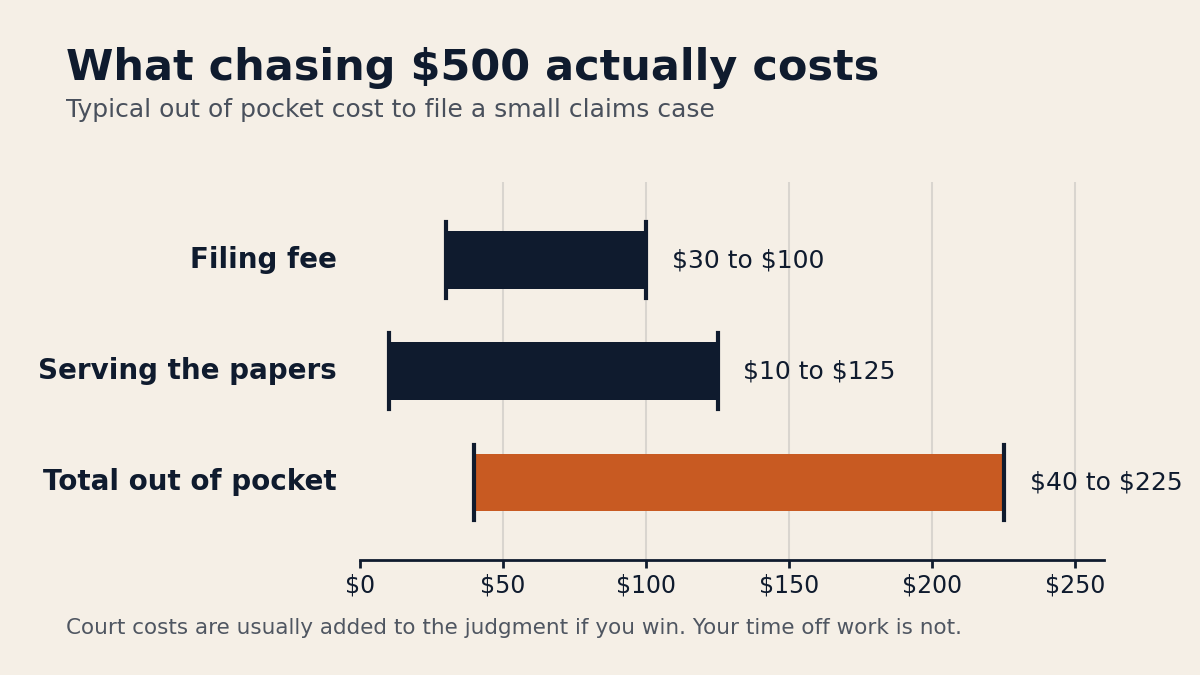
The filing cost, at least, is small. Most courts charge $30 to $100 to open a case this size, and in most states the judge can add that fee to what the other side owes you if you win. The fee almost never decides it.
The better question isn’t is it worth going to small claims court for $500. It’s whether the person on the other side can actually pay you once a judge says they have to. Winning and collecting are two separate jobs, and the court does not do the second one for you.
What filing a $500 case actually costs
Two real costs come before you ever walk into a courtroom: the filing fee and getting the papers delivered.
Filing fees are tiered almost everywhere, which works in your favor on a claim this size. California charges between $30 and $100, with the cheapest tier for the smallest claims, and plenty of states land nearby. If money is tight, every state offers a fee waiver for people on public benefits or under an income line. It’s one form.
Then you have to serve the defendant, which just means officially delivering a copy of the claim. Having the clerk mail it is usually cheapest, around $10 to $20. A sheriff or a private process server runs more, commonly $30 to $125, but is a lot harder for someone to dodge.
Add those together and a $500 case usually costs somewhere between $40 and $225 out of pocket. On a claim this size that’s real money. It also isn’t the deal breaker people assume.
Is it worth going to small claims court for $500 once you count your time?
Time is the cost people underestimate. After you file, a hearing is typically set a month or two out, on a weekday during business hours. Unless your schedule bends easily, you’re giving up part of a work day.
Then there’s prep. Getting your texts, receipts, photos, and contract into a clean packet takes an evening or two. Doing that properly is most of what wins these cases.
Call it half a work day plus a few hours at the kitchen table. Lose four hours of pay at $25 an hour and that’s $100 no judge will ever hand back to you.
You can get your court costs back, but not your afternoon
Here’s a distinction worth knowing before you file. In most states the judge can add your filing fee and your service costs to the judgment, so a $500 claim becomes something closer to $565 the moment you win.
What you generally can’t recover is everything else. Lost wages, gas, parking, and childcare are usually on you, win or lose, and so are the hours you spent organizing evidence. Attorney fees are normally off the table too, which is a big part of why hiring a lawyer over $500 rarely pencils out. We worked through where that line sits in is it worth hiring a lawyer for small claims court.

What really decides it is whether they can pay
A judgment is a court’s official statement that someone owes you money. It is not money. Nobody hands you a check at the end of the hearing.
In California you have to wait 30 days after the judgment before you can start collecting, which gives the other side room to appeal. After that, if they still haven’t paid, they’re supposed to send you a written statement of what they own, where they work, and where they bank. Ignore that and you can ask the court to haul them in for a debtor’s examination, under oath.
California’s own court guide puts it plainly: collecting can take a lot of time and money, and you may not collect any of it. You can read their page on what happens after you win.
So ask yourself one thing before you file. Does this person have a paycheck you could garnish, a bank account you could levy, or a business with a storefront and a license worth protecting? If the answer is no to all three, a judgment against them is a piece of paper you can frame.
There’s one consolation. Judgments last. A California judgment is good for 10 years and can be renewed, and the unpaid balance earns interest at 10 percent a year. Someone who’s broke today might have a job in three years. Our guide to collecting a small claims judgment covers the tools.

When $500 is worth chasing
The cases that pay off share a pattern. File when:
- The defendant is a business with a real address and a license. Businesses tend to pay, because a judgment on the public record costs them more than $500.
- They hold a steady job, or you know where they bank.
- You have written proof: a contract, a text thread, a receipt, dated photos.
- They already offered you part of the money, which is close to an admission.
- The work was done by someone licensed and bonded, since a surety bond gives you a second place to collect.
Sue when the money exists and your paperwork is boring. Boring evidence wins these cases.
When it usually isn’t
- You don’t know where the person lives or works, so you can’t get them served.
- Others have sued them already and nobody has collected a dime.
- Your only proof is a conversation the two of you remember differently.
- The deadline to sue has passed. Every state sets a statute of limitations, and for some claims it runs as short as a year or two.
- They live several states away, which turns a simple case into an expensive one.
None of that makes your claim wrong. It just makes it expensive to be right.

Send one letter before you file
This is the highest return hour you’ll spend on the whole thing. Most states don’t require a demand letter, but one costs a stamp and settles a surprising number of these disputes.
Keep it short. State what you paid, what you didn’t get, the exact amount you want back, and a deadline of 10 or 14 days. Say plainly that you’ll file in small claims court if you don’t hear back. Send it certified mail.
Two things can happen. Some people just pay, because a specific number with a date attached lands differently than an angry voicemail. And if they don’t, you walk into the hearing with proof you tried to settle it, which judges notice.
How it played out for Denise
Denise sent the letter first. She wrote that she’d paid $500 on March 3rd, attached a photo of the canceled check and one of the ceiling, and gave him 14 days.
He never answered. She filed, paid a $50 filing fee, and had the clerk serve him by certified mail for $15. Her hearing came up seven weeks later. She brought the check image, the letter, the mail receipt, two photos, and a one page timeline.
He didn’t show. She got a default judgment for $565 including her costs, and then he ignored that too. She tracked down his bank, which she only managed because his invoice listed an account for deposits, and started a levy. The money landed in month five.
About ten hours of her life, $565 back, and it only worked because he was findable. Make him a man with no job and no account and those same ten hours buy nothing.

Common mistakes people make over a small claim
- Suing the wrong name. If it’s a business, sue the exact legal name on its registration, not the name on the sign. A judgment against a name that doesn’t exist is worthless.
- Waiting too long. Courts enforce statutes of limitations without sympathy.
- Asking for a number you can’t prove. Padding the claim makes a judge doubt the parts that are true.
- Showing up with a story instead of a folder. Bring documents in order, with a copy for the judge and one for the other side.
- Filing before thinking about collection. Five minutes on that question saves months later.
Key takeaways
- Filing a $500 case usually costs $40 to $225 all in, and the winner can normally add that to the judgment.
- Expect a hearing one to two months out, on a weekday, during business hours.
- Your lost wages, travel, and prep time are not recoverable.
- Winning is the easy half. The court will not go collect the money for you.
- If the other side has no job, no bank account, and no business, a judgment may never turn into cash.
Frequently asked questions
Is it worth going to small claims court for $500 if the other person is broke?
Often it’s still worth filing, just not worth spending much on collection yet. A judgment lasts years in most states and can be renewed, so filing keeps the claim alive while their situation changes.
Can I get my filing fee back?
If you win, judges in most states will add the filing fee and your service costs to the judgment. That doesn’t mean the other side pays it. It means they owe it.
Do I need a lawyer for a claim this small?
No, and in a few states, California among them, you can’t bring one to the hearing at all. We go through the rules state by state in can you have a lawyer in small claims court.
What if they don’t show up?
You’ll usually get a default judgment, as long as you can show they were properly served. Bring your proof of service.
Is $500 too small for small claims court?
These courts set maximums, not minimums, and those run from a couple thousand dollars up to $20,000 or more. Ours are listed in small claims court limits by state.
The bottom line
A $500 claim is worth filing when the other side is findable and has something to take. The fee is minor, the evidence is usually a text thread and a receipt, and plenty of defendants settle the moment real paperwork shows up. For the mechanics, we walk through the filing steps in how to sue someone in small claims court.
When the other side has nothing, the answer changes. You can still win. You just may never get paid, and knowing that going in is worth more than any clever legal tip.
This article is general information only and is not legal advice. Reading it does not create an attorney client relationship. Laws vary by state and change over time. For advice about your own situation, please consult a licensed attorney in your state.