
Ray spent a week getting ready for his court date. A contractor had taken $3,200 for a bathroom job, torn out the old tile, and then stopped answering the phone. Ray had photos, texts, a signed estimate, and a bank record of the payment. What he didn’t have was any idea whether he was allowed to walk into that courtroom with an attorney beside him, or whether he’d look foolish showing up alone.
That question stalls a lot of people, and the answer is stranger than you’d expect. It depends almost entirely on which state’s courthouse you happen to be standing in.
So can you have a lawyer in small claims court? In most of the country, yes. A few states flatly forbid it. And in every state, allowed or not, hiring one for a claim this size usually costs more than the claim is worth.
Can you have a lawyer in small claims court in your state?
Small claims court was built for regular people. The whole idea was a room where you could tell a judge what happened, hand over your receipts, and get a decision without paying a professional to translate for you.
Most states kept attorneys in the picture anyway. In New York, Texas, Florida, Illinois and the majority of the rest, you can bring one if you want one. Nobody stops you at the door.
A handful of states went the other direction and shut lawyers out completely. California, Michigan and Nebraska do not let an attorney represent you at a small claims hearing.
The states that say no
California is the clearest example. Section 116.530 of the Code of Civil Procedure bars an attorney from taking any part in the conduct or defense of a small claims action. The only exceptions are narrow ones, like a lawyer suing in their own name, or a partnership or professional corporation made up entirely of attorneys.
Michigan’s small claims rules do the same thing. An attorney can’t file, prosecute or defend a small claims case unless it’s their own. They can, though, ask to move the case out of the small claims division and into district court, where the ordinary rules apply again.
Nebraska’s small claims statute is just as blunt. No party may be represented by an attorney. An individual represents themselves, a partnership sends a partner or an employee, and a corporation sends an employee.
If you live anywhere else, start from the assumption that lawyers are welcome, then confirm it on your own county court’s website before you plan around it. Rules get amended, and local courts publish their own instructions.
What happens when the other side is a business
This is the part that worries people most. A company can’t physically walk into a courtroom, so somebody has to appear for it. In states that allow attorneys, that somebody may well be one.
In states that don’t, the company generally sends an officer or an employee with authority to settle the case. New York, Texas and Florida all let a business appear through an authorized employee instead of counsel.
So the nightmare version, you alone against a corporate legal team, is rarer than it sounds. It isn’t impossible, though, and the clerk’s office will tell you what your court allows if you call and ask.
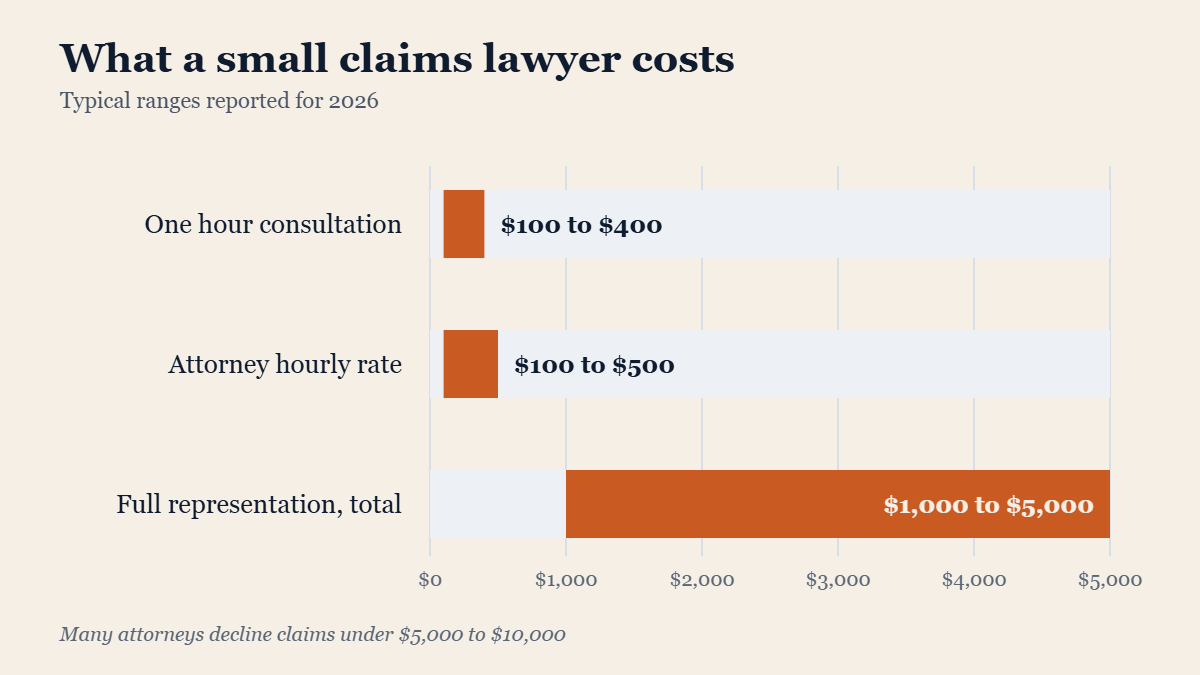
What hiring a lawyer actually costs
Here’s where the question tends to answer itself. Attorneys who take these disputes commonly charge somewhere between $100 and $500 an hour, and a single sit down consultation typically runs $100 to $400.
Full representation on a straightforward matter is often quoted in the range of $1,000 to $5,000 once the hours and the filing fee are counted. Put that against a $3,000 claim and the arithmetic gets ugly fast.
Plenty of lawyers won’t take the case at all. When the likely recovery sits under roughly $5,000 to $10,000, the fee swallows the award, and nobody walks away happy. If you’re weighing this decision in dollars, our longer breakdown on whether it’s worth hiring a lawyer for small claims court runs the numbers.
You usually can’t make the loser pay your legal fees
Courts here follow what’s called the American rule. Each side pays its own attorney, win or lose, unless a statute or a written contract says otherwise.
You can normally recover your filing fee and your service costs from the losing party, but not what you spent on a lawyer. That changes only if your agreement contained a fee clause, or a specific consumer protection law covers your type of claim.
Go read whatever you signed. A lease, a repair contract or a service agreement with an attorney fee provision buried in it can flip the whole calculation.

When bringing an attorney is genuinely worth it
There are real cases where the money makes sense, assuming you can have a lawyer in small claims court where you live:
- Your claim sits near the top of your state’s small claims limit and the facts are genuinely tangled.
- A contract or a statute lets the winner recover fees, so the cost may come back to you.
- You’re the defendant, and losing would mean a judgment on your record or a counterclaim you didn’t expect.
- The dispute is really a business matter wearing small claims clothing, with a relationship or a license behind it.
- The case is headed for appeal.
Outside those situations, most people do better representing themselves and spending the money on evidence instead. A second contractor’s written quote, certified mail receipts, printed photos. That kind of thing wins these cases far more often than eloquence does.
Appeals are the exception, in every state
Even the states that ban attorneys open the door once somebody appeals. In California an appeal is a completely new hearing in front of a different judicial officer, and both sides are allowed to have a lawyer at that stage.
The window is short. California gives you 30 days from the date the court mails the judgment. Other states set their own deadlines and some are tighter, so check yours the same day the decision arrives, not the week after.
An appeal is also where an attorney starts earning the fee, because the other side may well bring one of their own.

What to do instead of hiring one
You’ve got more options than “full representation” or “walk in blind.” The middle ground is where most people should live.
- Buy one hour of advice. A single consultation on your specific facts costs a fraction of representation and often changes how you present the case.
- Use the court’s self help center. Many courts staff an advisor who walks you through the procedure at no charge.
- Ask an attorney to review your written claim and your evidence without appearing for you. Some will do this as a flat fee task.
- Read your own court’s small claims guide. California’s is a good model at the California Courts self help site.
- Walk through the filing steps first in our guide on how to sue someone in small claims court.
Ray, the man with the half finished bathroom, did exactly this. He paid an attorney $175 for one hour, got told to lead with the signed estimate and the written quote from the contractor who finished the job, and filed the case himself. He won $3,200 plus his filing fee. Representation would have cost him most of it.

Common mistakes people make
- Assuming an attorney is required. In small claims, they never have been. Most people who win these cases handled them alone.
- Assuming an attorney is allowed. Paying a retainer in California, Michigan or Nebraska buys you someone who can’t stand up beside you.
- Hiring one for a claim too small to carry the fee, then feeling cheated by a win.
- Skipping the free intake call because it feels like a sales pitch. It’s also free information.
- Letting the appeal deadline run out while shopping around for representation.
Key takeaways
- Most states let you bring an attorney to small claims court. California, Michigan and Nebraska do not.
- Even where it’s permitted, the cost usually outruns the benefit on a claim this size.
- Winning rarely means the other side pays your legal bill, unless a contract or statute says so.
- A business opponent is often represented by an employee, not a lawyer.
- Appeals are the exception. Attorneys are allowed, and the deadlines are short.
Frequently asked questions
Can you have a lawyer in small claims court in California?
Not at the original hearing. State law keeps attorneys out of the conduct or defense of a small claims case, with only narrow exceptions. If the case is appealed, both sides may be represented.
Do I need a lawyer for small claims court?
No. These courts were designed for people without one. Judges are used to hearing from regular folks and will usually ask the questions needed to get your story out.
Can an attorney help me prepare even if they can’t appear?
Yes, and this is the smart play in states that bar them from the hearing. Advice, document review and coaching are all fair game. Only the appearance itself is off limits.
Will the judge think less of me for coming alone?
No. In most small claims sessions, almost nobody has counsel. Showing up organized, on time, and with your documents in order counts for far more.
What if the other side brings an attorney and I don’t have one?
The judge still runs a simplified hearing and still expects plain facts. Bring your evidence in order, answer what you’re asked, and don’t try to argue law. If it worries you, that’s a good reason to spend an hour with a lawyer beforehand.
The bottom line
Whether you can have a lawyer in small claims court comes down to your state, and whether you should comes down to arithmetic. For most claims, the honest answer is that the money is better spent on preparation than on representation.
Win, and the next problem is getting paid. That’s a separate skill, and we’ve covered it in how to collect a small claims judgment.
This article is general information only and is not legal advice. Reading it does not create an attorney client relationship. Laws vary by state and change over time. For guidance about your own situation, please consult a licensed attorney in your state.