
The phone rang for the third time before nine in the morning. Ray, retired six years and living on a fixed income, already knew the voice on the other end. Some collector he’d never heard of, calling about a credit card he closed back around 2016, telling him that if he didn’t pay something today, the papers were going out.
He hung up and sat there with the phone still in his hand, wondering the thing almost everybody wonders at that exact moment. Is this where you call a lawyer?
Here’s what most people miss. A collector calling you and a collector suing you are two completely different problems, and only one of them usually needs a lawyer. The calls are a nuisance. A lawsuit is an emergency with a deadline attached. Figuring out which one you’re actually facing is most of the work.
So when folks ask me, do I need a lawyer for debt collectors, my answer starts with a question of my own: has anybody filed anything in court yet?
The calls and the lawsuit are two separate problems
Track one is contact. Letters, voicemails, texts, calls at dinner. Irritating and sometimes scary, but nothing about it changes what you owe or what anyone can take from you.
Track two is court. Somebody hands you a summons and a complaint, or leaves them with an adult at your house. Now a judge is involved, a clock is running, and the outcome can reach your paycheck.
Most people who call an attorney are still on track one, where a few free letters would have done the job. Most people who ignore the problem are already on track two, which is exactly backwards.

When you can handle a collector yourself
If nobody has sued you, you have real tools and none of them cost anything but a stamp.
Ask for validation. A collector has to send you a notice describing the debt, and you generally get 30 days to dispute it in writing. Send that dispute and the collector has to stop collecting until it mails you proof. Plenty of old accounts have been sold three or four times and the paperwork simply isn’t there anymore. Our free debt validation letter template walks through the wording.
Tell them to stop calling. A written request to cease contact ends the phone calls, with narrow exceptions such as telling you they’re filing suit.
Check the age of the debt. Every state caps how long a collector has to sue you, and once that window closes the debt is time barred. Our guide to the statute of limitations on debt by state has the numbers.
Keep a log. Date, time, name, what was said. It costs you nothing and it’s the entire foundation of any claim you might bring later.
Do I need a lawyer for debt collectors who have already sued me?
This is the situation where the answer changes, and it changes fast.
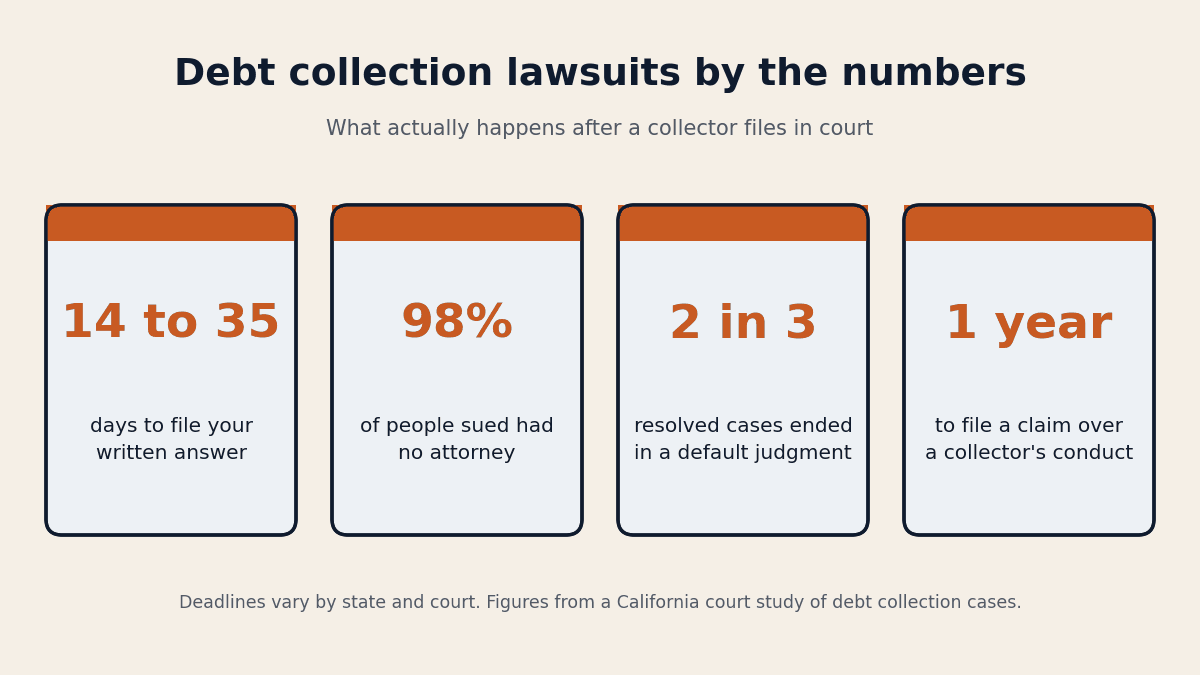
Once you’re served, you have to file a written answer with the court. Depending on your state and the type of court, that deadline usually falls somewhere between 14 and 35 days. Miss it and the collector asks the judge for a default judgment, which is a win by forfeit.
A judgment lets them garnish your wages, freeze your bank account, and put a lien on property. That’s the difference between a phone call and a court case, and it’s why the summons is the one piece of mail you never set aside.
Here’s the part that ought to bother everybody. In a study of California debt collection cases, more than 98 percent of the people being sued had no attorney, and almost two out of every three resolved cases ended in a default judgment for the collector. Most defendants never filed anything at all.
You’re allowed to file the answer yourself, and many courts hand out fill in the blank forms for exactly this. Doing that alone puts you ahead of most people in the room. But bring in a lawyer if the amount is large enough to hurt, if you’re not sure the company suing you actually owns the debt, or if you look at the forms and freeze.

When the collector is the one breaking the law
The Fair Debt Collection Practices Act sets the rules, and collectors break them constantly. Calling before 8 in the morning or after 9 at night. Threatening arrest. Telling your sister what you owe. Calling more than seven times in seven days about one debt, which regulators treat as harassment on its face.
If that’s happening to you, the question flips around. You’re not hiring somebody to defend you. You’re the one with a claim.
Win an FDCPA case and you can recover up to $1,000 in statutory damages without proving you lost a dime, plus any actual losses, plus your attorney’s fees. There’s a catch worth circling: you have one year from the date of the violation to file. Sit on it and a good claim expires.

What hiring one actually costs
People assume a lawyer is out of reach here, and for harassment claims that’s usually wrong. Because the law shifts fees onto the losing collector, most consumer attorneys take these cases on contingency. If you win, the collector pays your lawyer, not you. That’s the whole design.
Defending a collection lawsuit is different, since there’s no pot of money at the end. Expect to pay by the hour or a flat fee, and ask about limited scope help, where an attorney reviews your answer or coaches you for a hearing instead of taking the whole case.
Before you pay anybody, check your local legal aid office and your state bar’s referral line. Many consumer firms give a free first consultation, and a fifteen minute call often settles the question of whether you need them at all.
One wrinkle: who is actually calling you
The federal law aims at third party collectors, the agencies and debt buyers who chase money owed to somebody else. The original bank or hospital collecting its own account generally sits outside it.
That gap is narrower than it sounds. More than 40 states have passed their own debt collection statutes, and a good number of them reach original creditors too. California’s Rosenthal Act is the best known example. So before you decide nothing applies, find out who’s on the other end of the line and check your own state’s rules.
How it went for Ray
Ray mailed a validation letter the same week, certified, and kept the green card. The calls stopped for a month. Then a letter came back from the collector with a single page printout, no signed agreement, no account history from the original bank.
Meanwhile he’d written down every call, including the two that came in at 7:20 in the morning and the one where an agent told him a warrant was coming. Those are violations, plainly.
He never did hire anyone to fight the debt. He took his call log to a consumer attorney who reviewed it free, took the harassment claim on contingency, and settled it in a few months. Ray paid nothing out of pocket. The old card debt, by then well past his state’s deadline, was never collected.
Not every story lands that neatly. But the moves that made it work, writing things down and answering in writing, are free and available to anyone.

Common mistakes people make when a collector calls
- Ignoring the summons. Nothing else on this list will hurt you as fast. A default judgment is far harder to undo than it is to avoid.
- Making a small payment to buy peace. In many states a partial payment or a written promise restarts the clock on a debt that was already too old to sue over.
- Handling everything by phone. Verbal agreements evaporate. Disputes, cease contact requests, and settlements all belong in writing.
- Giving out bank information. A collector who has your account number has options you didn’t intend to hand them.
- Waiting too long on a harassment claim. The one year window closes quietly, and most people never notice until it’s gone.
Key takeaways
- Calls and letters you can usually handle yourself with a validation letter and a written cease contact request.
- A lawsuit is a different animal. File an answer before the deadline, which runs roughly 14 to 35 days depending on where you are.
- Default judgments are the norm because almost nobody responds, not because the collector had a strong case.
- If a collector broke the rules, an attorney is often free to you, since the law makes the collector pay the fees.
- Federal protections aim at third party collectors, but your state’s law may cover the original creditor too.
Questions people ask
Can I just ignore a debt collector?
You can ignore phone calls, though a written cease contact request works better and creates a record. You can’t ignore court papers. Those two look similar in the mailbox and could not be more different in consequence.
What happens if I don’t respond to a collection lawsuit?
The collector asks for a default judgment and usually gets it. From there they can pursue wage garnishment, a bank levy, or a lien, depending on your state’s rules. The Consumer Financial Protection Bureau lays out the basic steps for responding.
Can a collector sue me over a very old debt?
They can file, and some do. But if the debt is past your state’s statute of limitations, that’s a defense you raise in your answer. It isn’t automatic. Say nothing and the judge never hears it.
Will a lawyer cost more than the debt is worth?
Sometimes, for a small balance. That’s what limited scope help and legal aid are for. On a harassment claim it’s a different calculation entirely, because the fees come out of the collector.
Do I need a lawyer to send a validation letter?
No. It’s a short letter you can write in ten minutes. Send it certified mail with return receipt and keep a copy.
The bottom line
Do I need a lawyer for debt collectors? For the calls, almost never. For a lawsuit, get help or at least get an answer filed. For a collector who crossed the line, call one today, because that clock is shorter than you think.
Ray’s mistake, the one he’d admit to, was sitting with that phone for three weeks before he did anything. The letter took him ten minutes.
This article is general information only and is not legal advice. Reading it does not create an attorney client relationship. Debt collection laws vary by state and change over time. Please consult a licensed attorney in your state about your specific situation.