A woman I’ll call Ruth once tried to sell the house she’d lived in for twenty two years. Everything was moving along fine until the title company called with bad news. There was a claim sitting on her house from a roofing job her late husband never fully paid off. Ruth had no idea it was there. She couldn’t close on the sale until she cleared it, and the buyers were getting nervous.
That surprise claim is called a lien, and it catches ordinary people off guard all the time. You can owe money without ever knowing that a piece of your property is quietly on the hook for it. So what is a lien, and what can you do if one lands on something you own? Let’s walk through it in plain terms.
What is a lien, in plain terms
A lien is a legal claim against your property that secures a debt. Think of it as a rope tied between what you owe and something you own. If you don’t pay, the person you owe can use that rope to pull value out of the property instead of just chasing you for the cash.
The property can be your house, your car, a bank account, or business assets. The key thing to understand is that a lien follows the property, not just you. It stays attached until somebody clears it, which is exactly why Ruth’s closing ground to a halt.
Some liens you agree to on purpose. Others get slapped on without your permission when you fall behind on a debt. That difference is the first thing worth understanding.
The main types of liens you’ll run into
Liens come in a handful of flavors. Most fall into two big buckets, plus a few specific kinds worth naming.
Voluntary liens (the ones you sign up for)
A voluntary lien is one you agree to. When you take out a mortgage, you’re handing the lender a claim on your home until the loan is paid. A car loan works the same way. These are consensual, meaning you signed for them with your eyes open, and they usually cause no drama as long as you keep up the payments.
Involuntary liens (the ones that show up uninvited)
An involuntary lien attaches under the law without you signing anything, much like a wage garnishment can start without your consent. These are the ones that catch people by surprise. Three kinds do most of the damage:
- Judgment liens. If someone sues you and wins, that court judgment can become a lien once the creditor records it against your property.
- Tax liens. Owe back taxes and ignore the notices, and the government can attach a claim to what you own. A federal tax lien is broad, reaching real estate, accounts, and more.
- Mechanic’s liens. A contractor, subcontractor, or supplier who does work on your property and doesn’t get paid can file one. Ruth’s roofing claim was this kind.
One more distinction. A specific lien attaches to a single asset, the way a mortgage only touches the house it paid for. A general lien is broader and can reach across most of what you own. A federal tax lien is the classic general one.
How a lien attaches to your property
A lien usually becomes official when the creditor records it in the public records, most often at the county recorder’s office where the property sits. That recording is the moment the claim gets teeth.
Once it’s on record, anybody who checks will find it. That includes any title company, buyer, or lender who looks before a sale or refinance. This is how Ruth’s old roofing debt surfaced years later. Nobody mailed her a reminder. It simply sat in the county records, waiting for the day a title search turned it up.
For a mechanic’s lien, a contractor generally has to file within a set window after the work wraps up, and that deadline varies by state. Miss it and the lien may not stand, which is one reason these get challenged.
Why lien priority matters
When more than one lien sits on the same property, they line up in an order. That order decides who gets paid first if the property is ever sold or foreclosed. The general rule most states follow is first in time, first in right, meaning whoever recorded earliest usually stands at the front of the line.
Priority isn’t always a simple race, though. Some liens get special treatment. A mechanic’s lien can relate back to the day the construction project started in certain states, so it may jump ahead of a loan recorded later. Property tax liens often sit at the very top no matter when they arrived.
Why care about the order? If you owe several people, priority tells you who actually holds the strongest claim on your property and who’s likely to be left with nothing.
How to get a lien removed
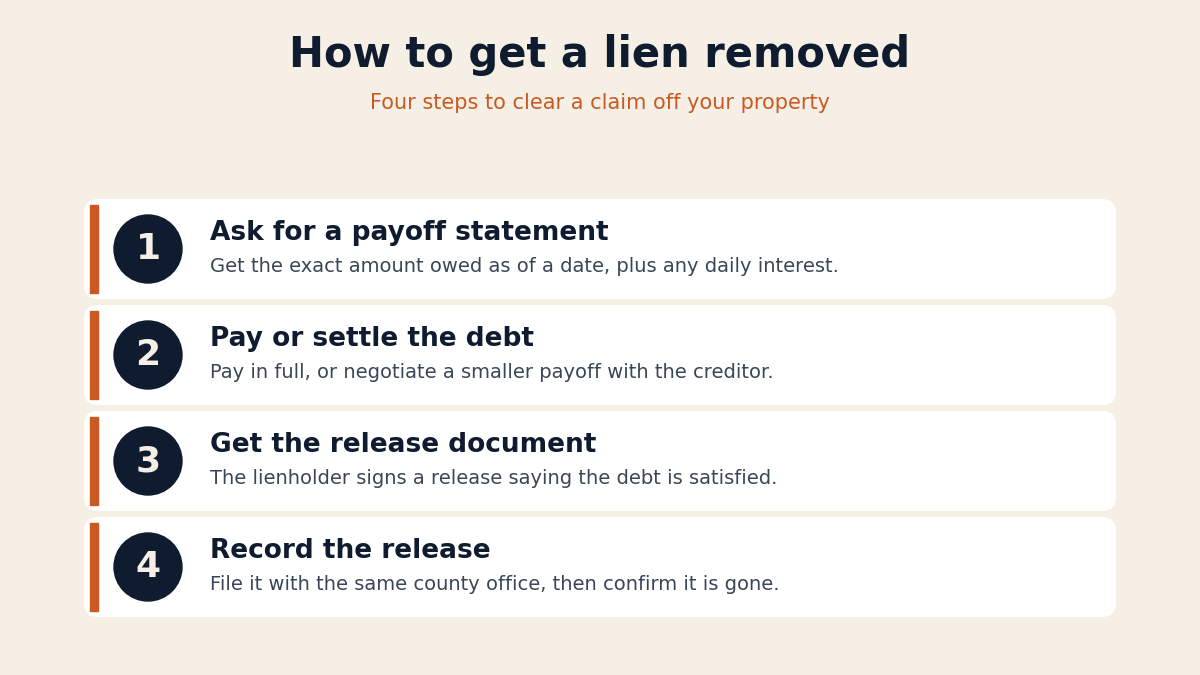
Most of the time, the way to clear a lien is to take care of the debt behind it. Once that’s done, the lienholder has a duty to release the claim. The process usually runs in four steps.
- Ask for a payoff statement. Contact whoever holds the lien and request the exact amount owed as of a specific date, plus any daily interest, so a late payment doesn’t leave you short.
- Pay or settle the debt. You can pay in full, or in some cases negotiate a smaller payoff, especially with a private creditor who’d rather get something than nothing.
- Get the release document. Once you’ve paid, the lienholder signs a release of lien, the official paper that says the debt is satisfied.
- Record the release. File that release with the same county office that recorded the lien, then check the records to confirm it’s gone.
Timing on the release varies. With the IRS, for instance, a federal tax lien gets released within 30 days after the tax debt is paid in full. A county office might process a recorded release the same day or take a few weeks. Either way, don’t assume it happened. Pull the record and see it for yourself.
You can read more about how creditors collect after a court win in our guide on how to collect a small claims judgment, since a recorded judgment is often what turns into a property lien.
What to do if a lien shouldn’t be there
Not every lien is valid. Sometimes one gets filed by mistake, misses a legal deadline, or is flat out wrong. You’ve already paid, or the amount is inflated, or the contractor never had the right to file in the first place.
Start by contacting the lienholder in writing and asking them to fix it. Keep copies of everything. If they won’t budge and you believe the lien is improper, you can ask a court to remove it. That’s a spot where talking to a lawyer in your state really pays off, because the rules and deadlines for challenging a lien are specific and unforgiving.
The federal government explains its own process on the IRS page about understanding a federal tax lien, which is a solid starting point if taxes are the issue.
Common mistakes people make
- Ignoring the notices. Liens rarely appear out of thin air. There’s usually a paper trail of warnings first, and tossing that mail only makes it worse.
- Paying without getting a release. Handing over money isn’t the finish line. Without a recorded release, the lien can still show up and block a sale.
- Assuming it went away on its own. An old debt might feel forgotten, but the lien can sit on record for years, waiting.
- Skipping the payoff statement. Guess the balance and you may pay a few dollars short, which can hold up the release.
- Waiting until closing day. Finding a lien the week you’re trying to sell is a scramble. A quick title check ahead of time saves the panic.
Key takeaways
- A lien is a legal claim that ties a debt to something you own, and it follows the property until it’s cleared.
- Some liens are voluntary, like a mortgage. Others, like tax, judgment, and mechanic’s liens, attach without your say so.
- A lien becomes enforceable once it’s recorded in the county’s public records, and it’ll surface in any title search.
- To remove one, satisfy the debt, get a release of lien, and record that release with the county.
- If a lien is wrong or improperly filed, you can dispute it and, if needed, ask a court to strike it.
Frequently asked questions
Does a lien mean I’ll lose my property?
Not by itself. A lien is a claim, not a seizure. It mainly ties up your ability to sell or refinance until it’s paid. Certain liens can lead to foreclosure if the debt goes unpaid long enough, but that’s a separate legal process with its own steps and warnings.
How do I find out if there’s a lien on my house?
You can search the property records at your county recorder’s or clerk’s office, and many counties let you do it online. A title company can also run a search for you, which is common before any sale or refinance.
Can a lien be placed without telling me?
In practice, most liens follow warnings you should have received, like collection notices or a lawsuit. That said, people miss mail and forget old debts all the time, so it’s entirely possible to have a lien on record you didn’t know about, just as Ruth did.
How long does a lien last?
It depends on the type and your state’s law. Some expire after a set number of years unless renewed. A federal tax lien, for example, generally stays active for ten years from when the tax is assessed. Others last until the debt is paid and the release is recorded.
Can I sell a house that has a lien on it?
Usually the lien has to be paid off at or before closing, often straight out of the sale proceeds. Buyers and their lenders want clear title, so the lien gets settled as part of the deal rather than left for the new owner.
The bottom line
A lien isn’t the end of the world, but don’t shrug it off either. If you know one exists, get a payoff statement, clear the debt, and make sure the release gets recorded. If a claim shows up that you don’t recognize, don’t panic and don’t pay blindly. Ask questions first.
This article is general information only and isn’t legal advice. Reading it doesn’t create an attorney client relationship. Laws about liens vary by state and change over time, so please consult a licensed attorney in your state about your specific situation.