
The rent was nine days late. Ruben knew that. What he didn’t expect was to come home from a double shift, slide his key into the lock, and feel it stop halfway. His landlord had changed the locks and taped a note telling him to call the office. No court, no judge, just a locked door and a tired man on his own porch at midnight.
Here’s the part that surprised Ruben, and surprises a lot of renters: what his landlord did was against the law. Texas gives landlords real power, but it draws hard lines they can’t cross. A lot of what upsets renters here, a deposit that never comes back, a broken heater in July that nobody fixes, a changed lock, isn’t just unfair. It’s flatly illegal.
Once you know where those lines sit, you stop feeling helpless and start knowing what to ask for. Let’s walk through the rules that protect you.
Your deposit has to come back, and the clock is ticking
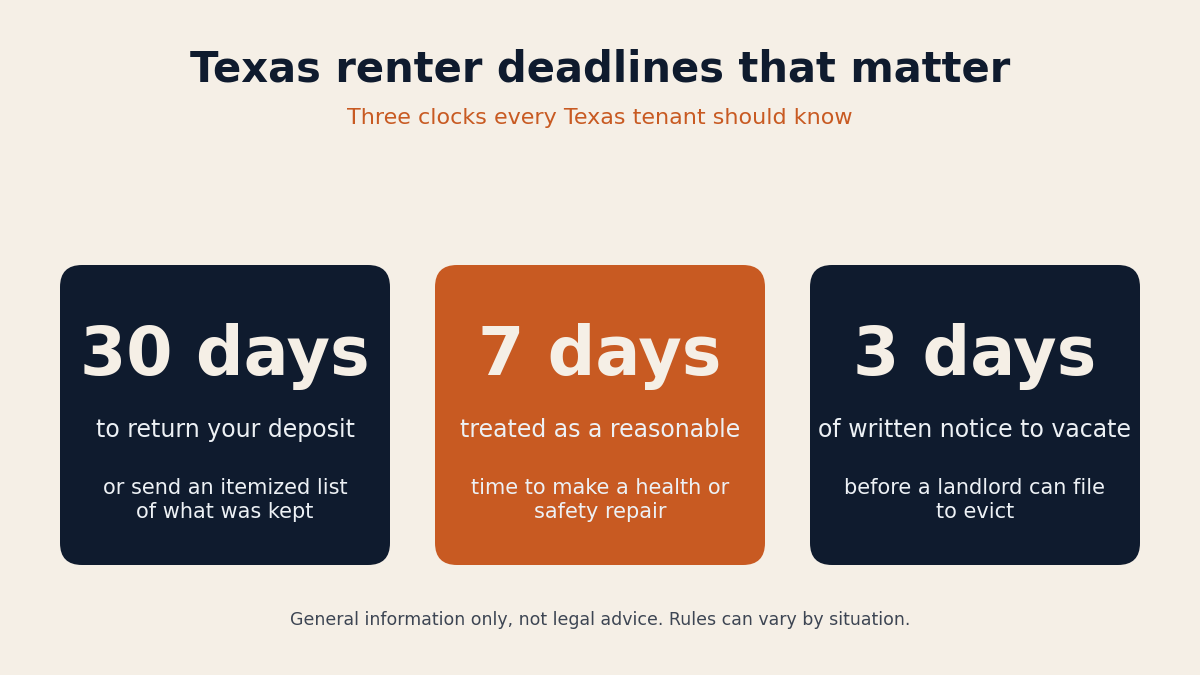
When you move out, your landlord has 30 days to either return your full security deposit or send you a written, itemized list of what they kept and why. That deadline lives in Section 92.103 of the Texas Property Code, and it isn’t a suggestion.
Two things start that clock. You have to actually move out, and you have to give the landlord a written forwarding address. Skip the address and you hand them an excuse to sit on your money, so put it in writing and keep a copy. The countdown runs from the day you surrender the place, not the day your lease ended.
A landlord can hold back money for real damage or unpaid rent, but not for ordinary wear. Faded paint, small nail holes, carpet worn from normal use, that’s the cost of renting to people, not something you owe for. If they keep part of your deposit, they have to say what each deduction was.
Miss the 30 day deadline in bad faith and the law bites back hard. Under Section 92.109, a landlord who wrongly keeps a deposit can owe you $100 plus three times the amount they held onto, plus your attorney’s fees. That penalty is why many deposit standoffs end with a check once the landlord sees you know the rule.
What Texas tenant rights say about repairs
Your landlord owes you a home that is safe to live in. Under Section 92.052, they have a duty to fix any condition that materially affects your physical health or safety, things like a busted heater, a gas leak, no running water, a roof that lets the rain in. This is where Texas tenant rights have real teeth, if you follow the steps.
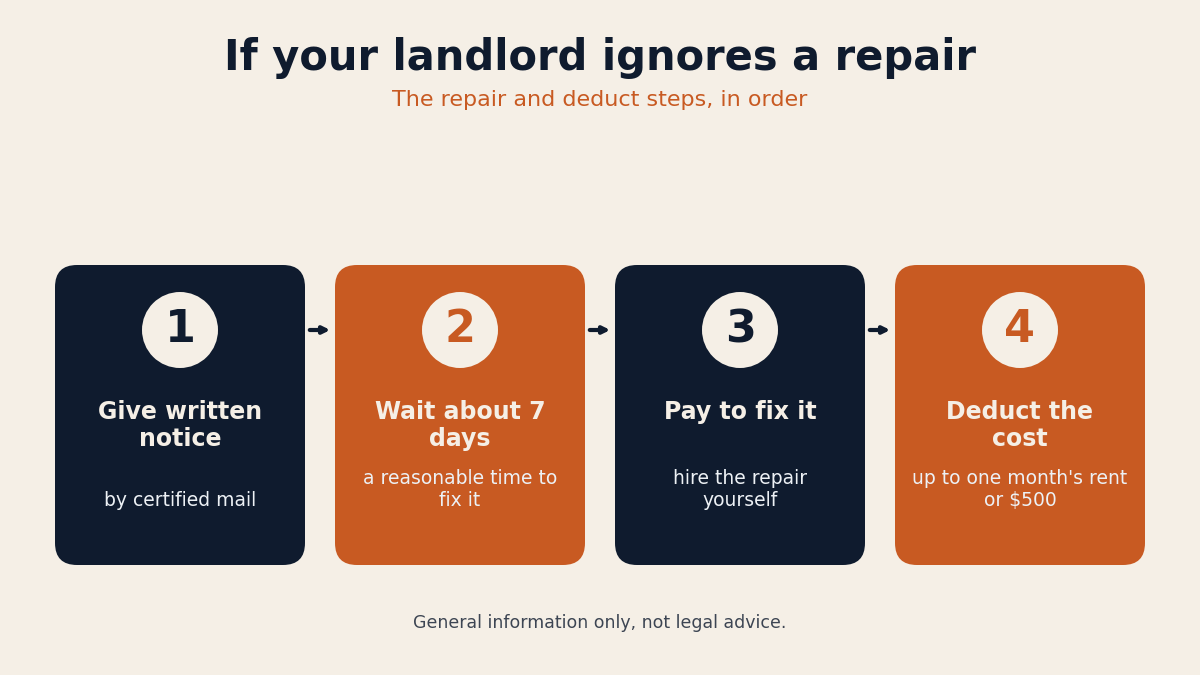
The steps matter, so read this part twice. You have to be current on your rent, and you have to tell your landlord in a way you can prove later, usually a dated letter sent by certified mail. A text you can’t dig up in six months won’t help you in court.
After proper notice, the landlord gets a reasonable time to make the repair. The law treats seven days as presumed reasonable for most problems, though a burst pipe in winter clearly calls for faster action than a slow drip. If they still do nothing, you have options. You can use repair and deduct, paying to fix the problem yourself and subtracting it from your rent, capped at one month’s rent or $500, whichever is greater. You can also end the lease or ask a justice of the peace to order the repair.
One warning worth its own sentence: don’t just stop paying rent because a repair is overdue. Withholding rent without following the exact legal steps can get you evicted, even when you were right about the repair.
Your landlord can’t lock you out or shut off your utilities
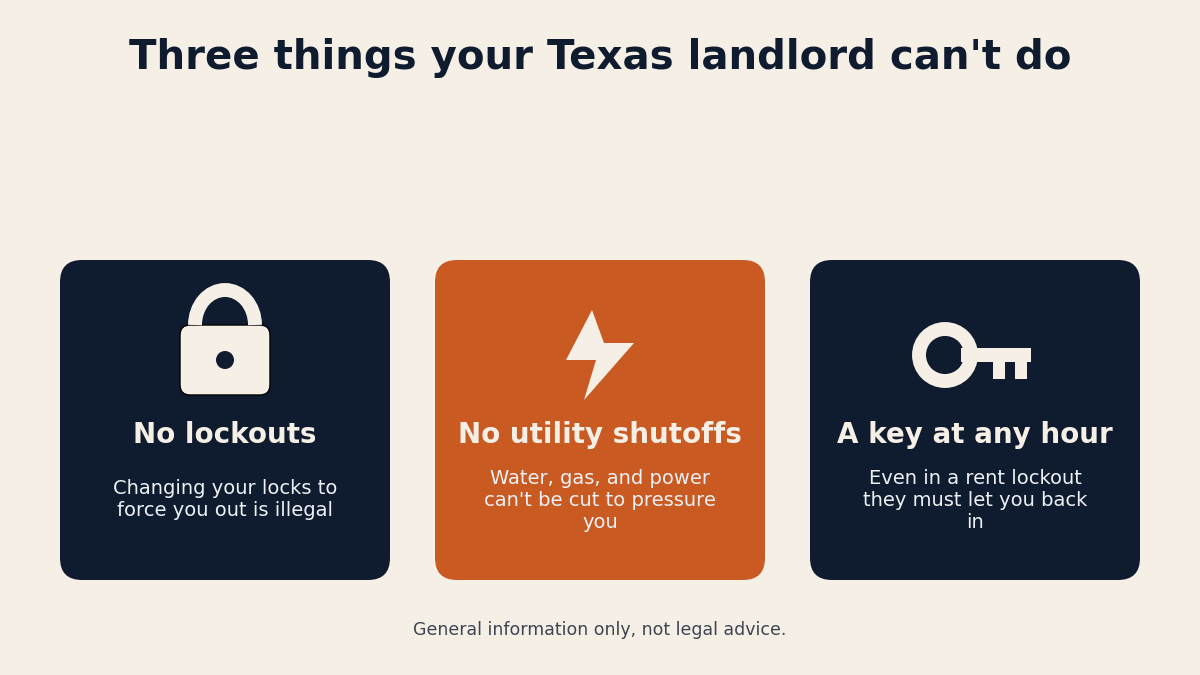
This is the rule Ruben’s landlord broke. A Texas landlord can’t lock you out, change your locks to keep you out, or shut off your water, gas, or electricity to force you out or pressure you into paying. Section 92.008 covers the utilities, and Section 92.0081 covers the lockouts.
There’s a narrow exception. A landlord can change the locks for nonpayment of rent, but only under strict rules, and even then they must give you a new key at any hour, whether or not you’ve paid, no questions asked. They can’t remove your doors, windows, or belongings, and they can’t cut the power except for genuine repairs, construction, or an emergency.
If your landlord locks you out illegally, the remedies are strong. A court can restore your possession or let you end the lease, and you can recover your actual damages plus one month’s rent plus $1,000, plus attorney’s fees and court costs. That’s a strong hand for a wronged tenant.
An eviction has to go through a judge
No landlord in Texas gets to evict you on their own. They can’t toss your things on the curb or bolt the door. Eviction is a court process, every time.
First comes a written notice to vacate, usually at least three days before they can file, unless your lease sets a different period. If the landlord still wants you out, they file an eviction suit and only a judge can order you to leave. If you plan to fight an eviction, act fast, because the deadlines are short. If the judge rules for the landlord, a constable enforces a writ of possession.
Texas changed some of this on January 1, 2026, when Senate Bill 38 took effect. The new law speeds up parts of the process, but it adds a tenant protection worth knowing: if you’re behind for the first time on the current month’s rent, the landlord generally has to give you a notice to pay or vacate, so you can catch up and stay. Notices can now also arrive by email or a delivery service if your lease allows it, so read yours.
Can your landlord just let themselves in?
Here Texas surprises people. Unlike many states, Texas has no statewide law setting a specific advance notice for a landlord to enter your unit. There’s no automatic 24 hour rule written into the Property Code.
What controls instead is your lease. Whatever it says about entry, notice, and reasons binds both of you, so read that clause before you sign. Most good leases promise at least a day’s notice except in an emergency. Even without a statute, courts expect landlords to act reasonably, so one who wanders in constantly can still be crossing a line.
A real example: how one renter used the rules
Marisol rented a small house in San Antonio, and one July the air conditioning quit while temperatures sat above 100. She didn’t just text and hope. She wrote a dated letter, sent it certified mail, and kept the receipt. She was paid up on rent, so she had every right to push.
Seven days passed with no repair. She called an HVAC company, paid $420 to get the unit running, and subtracted that from her next rent with the invoice attached. Because she stayed inside the repair and deduct rules, her landlord had no case. Her home cooled down, her rent stayed square, and she never set foot in a courtroom.
Common mistakes renters make
Knowing your Texas tenant rights only helps if you avoid the traps that sink good cases. These are the ones that come up again and again.
- Not leaving a forwarding address. Without it in writing, your deposit clock may never start, and you hand your landlord an easy excuse.
- Reporting repairs by phone or text only. If you can’t prove you gave notice, the law treats it almost like you never did. Put it in writing and keep a copy.
- Withholding rent the wrong way. Skipping rent to protest a repair, instead of following the repair and deduct steps, can get you evicted.
- Assuming a lockout is legal. It almost never is. If you’re shut out or your utilities are cut, that landlord is likely breaking the law and owes you money.
- Ignoring a notice to vacate. The deadlines are short. Waiting to respond can cost you the case before you ever explain your side.
Key takeaways
- Your landlord has 30 days after you move out and give a forwarding address to return your deposit or itemize deductions.
- A wrongly withheld deposit can cost the landlord $100, three times the amount, and your attorney’s fees.
- Repairs that affect health or safety are the landlord’s job once you’re current on rent and give written notice.
- Lockouts and utility shutoffs to force you out are illegal, and the penalties favor you.
- Eviction always goes through a court and a judge, never the landlord alone.
Frequently asked questions
How long does my landlord have to return my deposit in Texas?
Thirty days from the day you move out, as long as you’ve given a written forwarding address. By then they must return the full deposit or send an itemized list of deductions.
Can my landlord shut off my electricity if I’m behind on rent?
No. A landlord can’t cut off your water, gas, or electricity to pressure you into paying or leaving. The only exceptions are genuine repairs, construction, or an emergency.
How much notice does a landlord need to give before entering?
Texas has no statewide rule setting a required notice period. Your lease controls, so check what it says about entry. Most leases call for at least a day’s notice except in emergencies.
Can I stop paying rent until my landlord fixes something?
Not safely. Withholding rent on your own can get you evicted. Follow the repair and deduct steps instead: be current on rent, give written notice, wait a reasonable time, then deduct up to one month’s rent or $500, whichever is greater.
How many days notice before an eviction in Texas?
Usually at least three days of written notice to vacate before the landlord can file, unless your lease says otherwise. After that, only a court can order you out.
The bottom line
Renting in Texas doesn’t mean handing over your rights at the door. Your deposit has a deadline, your home has to be livable, and no landlord gets to lock you out or evict you without a judge. Understanding your Texas tenant rights turns a scary letter or a changed lock into a problem you can handle, often with nothing more than a certified letter and a clear head. Renting in another state? Our California tenant rights guide breaks that state down the same way.
This article is general information only and not legal advice. Reading it does not create an attorney client relationship. Laws change and can vary by state and by your specific situation. For advice about your own case, please consult a licensed attorney in your state.