
Six weeks after her mother’s funeral, Janine was still carrying a house key she wasn’t allowed to use.
The will was clear and the house was hers. But the bank wouldn’t talk to her, the gas company wanted paperwork she didn’t have, and the lawyer kept repeating four words that stop most families cold: not until probate closes.
Here’s the part nobody warns you about. Probate isn’t one appointment you show up for and finish. It’s a court supervised process with mandatory waiting periods built in, and most of that waiting has nothing to do with how organized you are.
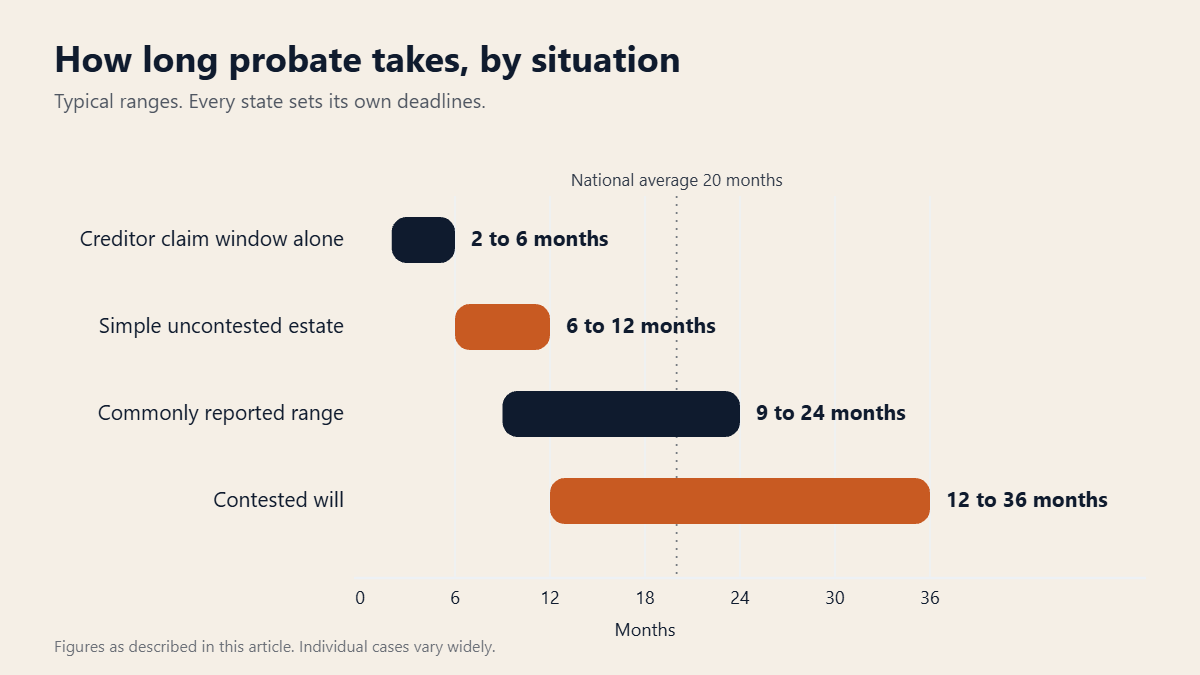
For a modest estate with a valid will and a family that agrees, plan on 6 to 12 months. Bigger or messier estates commonly run 9 to 24 months. One 2024 study by Trust & Will put the national average at roughly 20 months.
So how long does probate take in your family’s case? It comes down to four things you can size up in one afternoon at the kitchen table.
What actually sets the clock
Four factors do almost all the work. Your state, because every state writes its own waiting periods and some run twice as long as others. Whether anyone objects, since a single unhappy relative can turn a nine month case into a three year one.
What the estate owns, because cash in a bank account transfers easily and a house or a rental in another state does not. And the executor, since someone who returns calls and files on time finishes months ahead of someone who lets paperwork pile up on the counter.
Notice what isn’t on that list: how much the estate is worth. A tidy $2 million estate of stocks and savings often closes faster than a $180,000 estate with a house mid remodel and two siblings who aren’t speaking.
How long does probate take when nothing goes wrong
Where there’s a valid will, one cooperative executor, assets that are easy to value, and nobody arguing, most states move an estate through in 6 to 12 months. Simple cases in the faster states sometimes close in 3 to 6 months.
That baseline quietly assumes three things. The original will has to be findable, the heirs have to be locatable and willing to sign, and the estate has to pay its bills without selling anything complicated.
Miss one of those and you’re no longer in the best case. You’re in the middle of the range.

The probate timeline, stage by stage
It gets less mysterious once you see the five stages in order.
Opening the case and getting appointed
Someone files a petition in the county where the person lived, with the original will and a certified death certificate. The court notifies the heirs, gives them a window to object, then appoints the executor.
Those papers are called letters testamentary when there’s a will and letters of administration when there isn’t. Until they’re in hand, no bank will move a dollar.
Taking inventory of what the estate owns
The executor tracks down every account, deed, vehicle, and unpaid bill, then files an inventory with the court. Appraisals happen here, and a slow appraiser quietly costs you a month.
The creditor claim window
The executor publishes a notice and mails one to every known creditor, then waits. It runs in the background while other work continues, but it can’t be skipped or shortened by working harder.
Paying the debts and the taxes
Valid claims get paid, questionable ones get challenged, and the final income tax return gets filed. Most estates owe no federal estate tax at all, though the ones that do face a hard deadline.
Final accounting and distribution
The executor files a report showing every dollar in and out, the court reviews it, beneficiaries sign receipts, and a judge closes the estate. Families underestimate this stage most, because the court’s calendar sets the pace.

The creditor window is the floor nobody can move
If you remember one thing about probate timing, make it this one: every state forces the estate to sit and wait while creditors come forward, and nothing gets handed out until that window closes.
Most states give creditors two to six months after the executor publishes notice. Nebraska runs about two months, West Virginia about three. Massachusetts and Pennsylvania both give creditors a full year.
The starting gun differs too. California runs 4 months from the date the court issues letters, or 60 days from direct notice to a known creditor, whichever ends later. New York allows 7 months from letters. Ohio counts 6 months from the date of death, so the clock can already be running before anyone opens a case.
Even a flawless estate with one heir and no debts can’t beat its state’s window, which is why almost nobody finishes in under three months.
Five things that stretch probate past a year
Every honest answer to how long does probate take comes with exceptions. These five matter most.
- Someone contests the will, usually over mental capacity, undue influence, or a newer will turning up. Contested cases routinely run one to three years, sometimes longer.
- The estate owns real estate. Probate property sales commonly stretch a case to 9 to 24 months, against roughly 60 days for an ordinary sale.
- Property sits in another state, which usually means a second, smaller probate case there running on its own schedule.
- The estate owes federal estate tax. The return is due 9 months after the date of death, and while an automatic six month extension to file is available, it does not extend the time to pay.
- The executor stalls. Rarely out of malice. Grief, a demanding job, and a stack of unfamiliar forms are enough.
California put a number on that last one. The personal representative has to either ask the court to distribute the estate or file a status report explaining the holdup within one year of being appointed, or 18 months if a federal estate tax return is required.

When your family can skip probate entirely
Plenty of estates never see a courtroom, and that’s the fastest timeline there is. Anything with a living named beneficiary passes outside probate. Life insurance, retirement accounts, payable on death bank accounts, and property in a living trust go straight to the person named, usually within weeks.
Then there’s the small estate affidavit. Most states let you claim a modest estate with a signed form instead of a full case. Limits vary a lot. Many states sit between $50,000 and $100,000, while California allows roughly $208,850, Iowa $200,000, and Florida $150,000.
There’s almost always a short wait first, most commonly 30 to 45 days after the death, though Colorado allows 10 days and Kansas six months. Only assets that would have gone through probate count toward the limit, so a joint account doesn’t push you over the line.
How it actually went for Janine
Janine’s mother died in March. The will was straightforward, the house was paid off, and the two heirs got along fine.
She filed in April and waited five weeks for a hearing date. Her letters of appointment came through in May. The creditor notice ran in June, and her state made her hold the estate open four months from there.
While she waited, she found two things the will never mentioned: a $6,200 credit card balance and a small annuity with no beneficiary listed. The annuity took seven weeks of phone calls.
The final accounting went in that November. The judge signed the closing order in January, ten months after the funeral.
Nothing went wrong. Ten months was the good outcome.

Common mistakes that quietly add months
- Ordering too few death certificates. Every bank, insurer, and county office wants a certified copy of its own. Order ten at the start.
- Handing out money early. Give a beneficiary their share before creditors are paid and you can end up personally on the hook for the shortfall.
- Filing before you’ve found the will. Courts want the original, not a photocopy, and hunting for it afterward costs weeks.
- Treating the creditor window as dead time. Use it. Get the house valued, close small accounts, pull the tax records together.
- Hiring nobody, then hiring late. A lawyer brought in at month nine to fix a mistake costs more than one brought in at month one.
Key takeaways
- A simple, uncontested estate usually closes in 6 to 12 months. Complicated ones run 9 to 24.
- The creditor claim window, most often two to six months, sets a floor no amount of hustle can lower.
- Real estate, property in another state, federal estate tax, and family disputes are the four big delays.
- A contested will can add one to three years.
- Small estate affidavits and assets with named beneficiaries skip probate and settle in weeks.
Frequently asked questions
Can an executor be forced to move faster?
Sometimes. A beneficiary can petition the court to order an accounting, set a deadline, or in serious cases remove the executor. It’s a real remedy, though it adds a hearing to the calendar.
Does having a will make probate faster?
Usually, though it doesn’t skip probate. A valid will names an executor and spells out who gets what, which removes the guesswork. Dying without one means the court appoints an administrator and state law decides the shares, which takes longer.
Can beneficiaries get money before probate ends?
Often, yes. Many courts allow a partial distribution once it’s clear the estate can still cover its debts. Ask the court first rather than writing the check.
How long does probate take if the house has to be sold?
Add several months. Probate sales commonly push the whole case into that 9 to 24 month range, and in some states the sale needs court confirmation to close.
Does probate start automatically when someone dies?
No. Somebody has to file. Estates sit untouched for months because every relative assumed a lawyer or the county was handling it, and that delay gets added to everything else.
The bottom line
Probate is slow by design, not by accident. The waiting periods exist so creditors and heirs get a fair chance to speak up, and no filing fee or friendly clerk can shorten them. Six months to a year is the honest expectation for a clean estate.
If you’re the one holding the folder, order plenty of death certificates and read your state court’s probate self help page before you file anything. And if you’re reading this to plan ahead rather than to settle an estate, a clear will plus named beneficiaries on your accounts is the cheapest gift you can leave your family.
This article is general information only and is not legal advice. Reading it does not create an attorney client relationship. Probate laws and deadlines vary significantly by state, and the timelines here are general patterns rather than promises about any particular case. Please consult a licensed attorney in your state before making decisions about an estate.