
Three weeks after her husband’s funeral, Delores picked up the phone at her kitchen table and a stranger told her she owed nine thousand dollars.
He was polite about it. The balance on Frank’s credit card still had to be settled, he said, then he went quiet and waited for her to fill the silence. She had no idea whether he was telling the truth.
Almost every family gets some version of that call, and almost nobody knows the answer going in. So here’s the piece worth carrying around. Debt isn’t inherited the way a wedding ring is. It stays attached to the person who borrowed the money, which after a death means it stays with their estate. Delores didn’t owe that nine thousand dollars. Frank’s estate did, and only if there was money in it.
There are real exceptions and we’ll walk through all of them. They’re just far narrower than a collector on the phone will let you believe.
Your estate pays your debts, your family doesn’t
Everything you own the moment you die becomes your estate. The house, the truck, the checking account, the coin jar on the dresser.
Somebody has to settle it. Usually that’s the executor named in the will, or a representative the court appoints when there’s no will. The job is to inventory what’s there, notify the known creditors, pay the valid bills out of estate money, and hand what survives to the heirs. That process is probate.
Notice the order. The bills come out first, which means an inheritance is only whatever is left over, not a number anyone promised you. When there’s no will, state law still decides who inherits, but creditors are paid before any of that.
Understanding what happens to debt when you die starts with that distinction. Your estate is its own pot of money, separate from your children’s savings and your spouse’s paycheck, and it’s the only pot creditors get to reach into.
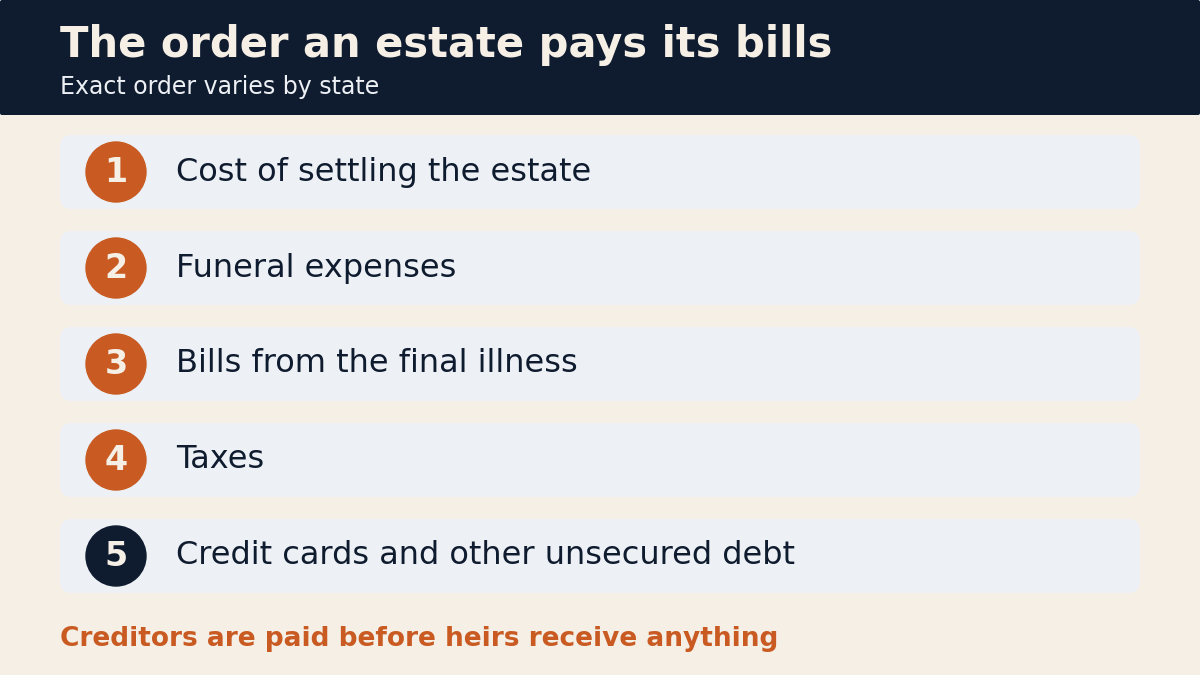
State law sets the payment order and the details vary, but the shape is similar nearly everywhere. The cost of settling the estate goes first, then the funeral, then bills from the final illness, then taxes, with credit cards near the bottom.
What happens to debt when you die with an empty estate
This is the part families dread most, and it has the kindest answer.
When an estate can’t cover what it owes, lawyers call it insolvent. The executor works down the priority list, pays each group in full until the money runs out, then splits what’s left in a group proportionally. When the money’s gone, it’s gone.
The credit card company at the bottom of that list gets whatever reaches it, which is sometimes nothing. And then the unpaid balance is simply written off. Nobody hands it to the children. Nobody attaches it to the widow’s paycheck.
Which is the most useful sentence here. Unless you signed something, you don’t pay a dead person’s bill out of your own money.

The five exceptions that can put you on the hook
Now the fine print, because collectors count on you not knowing it.
- You cosigned the loan. A cosigner promised to pay if the borrower didn’t, and a death doesn’t cancel that promise.
- You were a joint account holder. Two names means two people are liable, and the survivor owes the full balance. An authorized user on somebody’s card is a different thing, and generally isn’t liable for a dime.
- You live in a community property state. There, debts one spouse takes on during the marriage can belong to both, and a death doesn’t undo that. The list is Arizona, California, Idaho, Louisiana, Nevada, New Mexico, Texas, Washington, Wisconsin, plus Alaska if the couple signed a special agreement.
- You’re the executor and you paid the wrong people first. Hand out inheritances while valid bills sit unpaid and a court can look to you personally for the shortfall.
- Your state has a filial responsibility law. Roughly thirty states still have statutes saying adult children must support a parent who can’t support themselves, and in most of them the law sits unused for decades. Pennsylvania is the exception, where care facilities have actually sued adult children over unpaid nursing home bills.
Notice what isn’t on that list. Being someone’s child or sibling does not make their credit card yours.
The house, the car, and anything with a loan attached
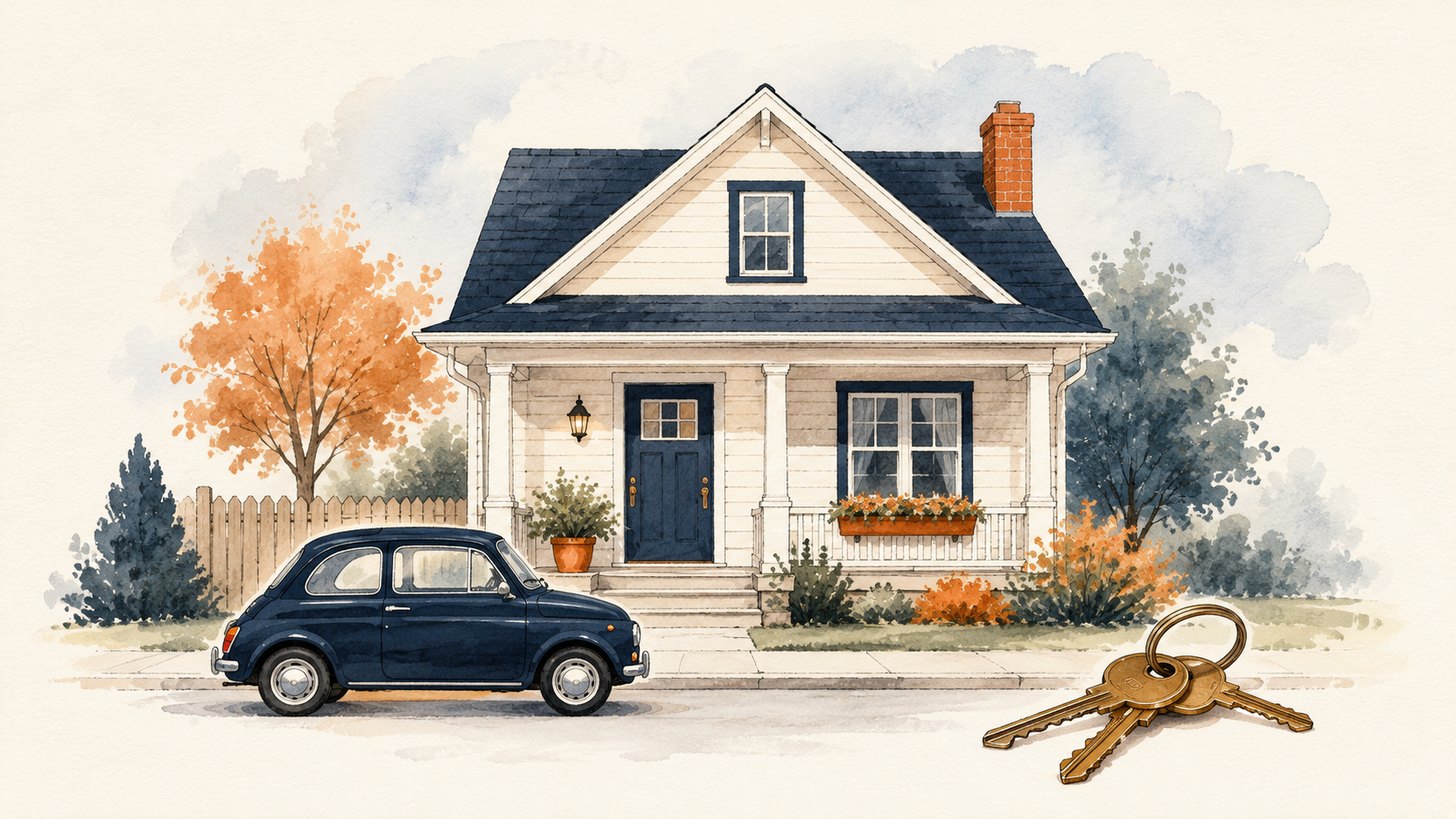
Secured debt behaves differently, because it isn’t chasing a person. It’s chasing a thing.
A mortgage attached to a house stays with that house no matter who ends up owning it. Keep making the payments and you keep the home. Stop, and the lender can foreclose, exactly as it could have while your mother was alive.
A federal law does protect relatives here. When a home passes to a relative because the owner died, the lender generally can’t demand the whole balance at once just because the deed changed hands. You’re allowed to keep paying the existing loan on its existing terms.
Car loans work the same way with less protection. Somebody keeps paying or the lender takes the car.

The money creditors usually never touch
Here’s what surprises people. Some money never becomes part of the estate. It goes straight to a named human being, out of reach of the estate’s creditors:
- Life insurance paid to a named beneficiary
- A 401(k) or an IRA with a living beneficiary on file
- Bank accounts set up as payable on death
- Anything already sitting inside a trust
There’s an expensive catch. If the beneficiary line is blank, or it names the estate instead of a person, that money drops into the estate and joins the pile creditors are picking through. So put a living person on every account that gives you the option, and check those forms after every divorce, death, and birth in the family.
Student loans and medical bills follow their own rules
Federal student loans are discharged when the borrower dies. That includes Parent PLUS loans, wiped out if either the parent who borrowed or the student they borrowed for dies. Someone has to send the servicer a death certificate, but the balance goes away and nobody inherits it.
Private student loans depend on the contract. Some lenders discharge the balance and some don’t. Federal law helps newer borrowers, though. For qualifying private loans taken out on or after November 20, 2018, a cosigner has to be released when the borrower dies.
Medical bills are handled like any other claim. The hospital files, waits its turn, and takes what the estate can pay. Where families do get pulled in is long term care, since unpaid nursing home balances are the one place those filial responsibility statutes have shown any teeth.
How it played out for Delores
Frank left about eighteen thousand dollars in a checking account in his name only, a paid off pickup, his half of the house, and a life insurance policy with Delores named on it.
The insurance never entered the estate. It went straight to her, and the card company had no claim on a dollar of it.
The nine thousand dollar card was Frank’s alone. Delores carried one with her name printed on it, but she was an authorized user, not a joint holder, and they lived in Ohio, which isn’t a community property state.
So the estate paid the funeral home, then the last hospital bills, then the card, and a few thousand dollars still reached their kids. Had that account been empty, the card would have gone unpaid and she still wouldn’t owe a cent.
What she did was ask for the debt in writing and stop taking the calls. It helps to know what a debt collector can and can’t do before you pick up.

Common mistakes families make
- Paying a bill out of your own checking account because it feels like the decent thing to do. Once you’ve paid voluntarily, getting it back is close to impossible.
- Believing the collector’s version of who owes it. Ask for it in writing. A caller who won’t put anything on paper may be running a scam.
- Handing out inheritances early, before the creditor window closes, which can leave the executor covering the gap.
- Letting the mortgage or car payment lapse while everyone waits on probate. Foreclosure and repossession run on their own schedule.
- Throwing out the paperwork. Statements, policies, and beneficiary forms prove who owed what and who was named on what.
Key takeaways
- Your debts come out of your estate. They aren’t handed down to your relatives.
- Creditors are paid before heirs, so an inheritance is only what survives the bills.
- If the estate can’t cover a debt and nobody else signed for it, the balance generally goes unpaid.
- The exceptions are cosigning, joint accounts, community property states, executor mistakes, and filial responsibility statutes.
- Life insurance and retirement accounts with a named living beneficiary usually skip the estate. Keep those forms current.
Questions people ask
Can a collector make me pay my mother’s credit card?
Not if you never signed for it. A collector may call to talk about the estate, but may not imply the balance is yours to pay from your own money. If the calls keep coming, complain to the Consumer Financial Protection Bureau.
Does a widow owe her husband’s medical bills?
Usually not, unless she signed the admission paperwork as a responsible party or her state makes spouses liable for that kind of bill. In a community property state the answer can flip.
What happens to a joint credit card when one holder dies?
The survivor owes the balance. A joint account has two borrowers, and losing one doesn’t shrink what the other agreed to pay.
How long do creditors have to file a claim?
Every state sets a window, often a matter of months, usually starting when the estate notifies creditors. Late claims are typically barred, which is why an executor shouldn’t rush to hand out money.
My father died with almost nothing. What now?
With no estate worth speaking of, there’s usually nothing to collect and often no reason to open probate. Tell any collector in writing that the estate has no assets, and keep a copy.
The bottom line
Strip the fear out of it and what happens to debt when you die comes down to two questions. What’s in the estate, and did anyone else sign? If nobody else signed, creditors are limited to whatever the estate holds, and the family can put the phone down.
This article is general information only and is not legal advice. Reading it does not create an attorney client relationship. Laws about estates and creditor claims vary by state and change over time. Please consult a licensed attorney in your state about your own situation.